


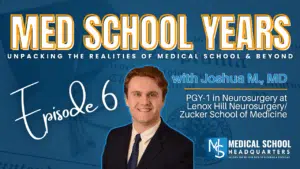
For most medical students, the first month of school is filled with lectures and anatomy labs. For Josh McBriar, it was the first step toward a life-changing career.
During a meet-and-greet with the neurosurgery department, a resident invited him to shadow overnight. “I didn’t even have scrub access,” Josh laughed. “The scrubs they gave me were too small. But I went anyway.”
That night, an elderly woman came in with a massive subdural hematoma. “The resident looked at me and said, ‘We’ve got to take that out. You can leave now, or if you stay—you have to help.’” Josh stayed.
Moments later, he was standing in the operating room, holding a drill. “I got to drill my first burr hole,” he recalled. “And I’ve never looked back since.”
It wasn’t just the adrenaline of the surgery that hooked him—it was the transformation that followed. “We brought the patient up to the ICU afterward, and she woke up. Seeing her come back, seeing her family’s faces—that’s what did it for me. That’s when I knew I’d do whatever it takes to become a neurosurgeon.”
Josh’s path to matching at Lenox Hill Hospital, home to one of the top neurosurgery departments in the world (and featured on the Netflix documentary Lenox Hill), wasn’t accidental—it was deliberate and deeply personal.
He started by reaching out. “I cold-emailed Dr. Michael Schulder, our program director, and said, ‘Hey, I want to be a neurosurgeon. How do I do this?’” Josh said.
That boldness paid off. Weekly meetings turned into mentorship. Mentorship turned into research opportunities. “By the time I was a fourth-year student doing my sub-internship, I knew the department inside and out. That’s when you really show what you’re made of—your clinical knowledge, your work ethic, your personality.”
And in neurosurgery, personality matters. “You’re with your residents for seven years,” Josh said. “They have to like you. They have to want you on their team.”
Behind the impressive stats—Lenox Hill’s neurosurgery program took only three residents this year—Josh is refreshingly honest about the stress that comes with competitiveness.
“You always have that voice in your head saying, ‘You have to be perfect,’” he admitted. “Perfect grades, perfect research, perfect step scores. It’s stressful.”
When he began medical school, Josh had minimal research experience. “You look at the data and realize neurosurgery applicants average over thirty research items,” he said. “I had none. That’s terrifying.”
But instead of comparing himself to others, Josh focused on learning the process. “No one’s going to put you on a paper just to put you on it,” he said. “You have to prove you can do the work—data analysis, writing, all of it. Your ability to contribute grows with your competence.”
He also leaned on something many students overlook: his humanity.
“You can’t just be locked in a library,” he said. “They want someone who can talk to patients, connect with colleagues, and live a balanced life.”
Josh, a former college athlete, kept up with intramural flag football at Hofstra and made time for friends and family. “You have to plan it,” he said. “For me, the gym was non-negotiable. I built it into my week. That’s what kept me grounded.”
Zucker School of Medicine’s curriculum begins with something unusual—EMT training. For Josh, it set the tone for hands-on learning.
“You’re riding along with paramedics on twelve-hour shifts your first month,” he explained. “You don’t know much, but you’re seeing patients in crisis. You bring them to the ER, drop them off, and think, ‘What happens next?’ That curiosity drives everything else.”
That early exposure shaped how he approached the rest of medical school—and what he valued in a program.
“It’s not about the name or prestige,” he said. “It’s about the health system. Zucker is tied to Northwell, which gave me access to incredible faculty and departments. I emailed our neurosurgery program director directly through my Northwell account. That kind of access changes everything.”
For students choosing schools, Josh’s advice is simple: “It’s not the name that makes you successful—it’s the opportunities you pursue.”
At Lenox Hill, research isn’t optional—it’s part of the culture. “Dr. Bookvar, one of our attendings, leads more clinical trials than any other neurosurgeon in the country,” Josh said. “There are over thirty active trials in the department.”
Josh found his place in that environment by developing his research skills one project at a time. “When you understand how to conduct research, you start reading papers differently,” he explained. “You can see what’s solid evidence and what’s not. That makes you a better physician.”
He also emphasized that research fuels the critical thinking residency programs are looking for. If you’re applying soon, MSHQ offers Residency Essay Editing and Residency Mock Interviews to help applicants communicate that kind of insight—and authenticity.
Even as he tackled the rigor of Step exams, Josh found ways to stay balanced. He scheduled early-morning workouts during rotations, took breaks for city dinners with friends, and approached learning as a marathon, not a sprint.
His most unexpected moment of joy? The OBGYN rotation he dreaded. “I told myself before medical school, ‘No way,’” he said with a grin. “But I ended up loving it. I delivered three babies. I got to suture C-sections. It was amazing.”
That openness, he believes, is crucial. “You might think you know what you want—but you should give everything a real shot. You’ll always learn something about yourself.”
When Match Day finally arrived, Josh was surrounded by friends who had shared every late-night study session and clinical rotation.
“It’s such a weird tradition,” he laughed. “You open an envelope at noon, and that decides your next seven years.”
He wasn’t just celebrating his own success—he was celebrating his friend’s too. “My best friend matched in cardiothoracic surgery at the same place. I think I was more excited for him than for myself.”
And when the confetti settled, the lesson was clear. “At the end of the day, it’s not about prestige,” Josh said. “It’s about happiness. If you’re not happy where you are, you won’t perform your best.”
For anyone still navigating that journey, Josh recommends mentorship. “Talk to someone who’s been through it,” he said. “Carlos Tapia helped me so much through the process.” (You can book a 1:1 Residency Advising Session with Carlos to get similar guidance.)
As Josh prepares for residency, what excites him most is the moment when the responsibility becomes his. “In my second year of residency, I’ll be the only neurosurgery resident in the hospital overnight,” he said. “I’ll handle emergencies. I’ll make decisions. That level of responsibility—it’s what I’ve been working toward.”
And when asked for his final piece of advice to premeds and medical students, he paused before answering.
“The impact you make—on patients, on families, on everyone who crosses your path—is infinite,” he said. “It’s hard, it’s exhausting, but it’s worth it. One day, you’ll change someone’s life. And that moment makes it all worth it.”